

Most design review meetings are a fucking waste of time.
You know the ones I’m talking about.
Thirty minutes scheduled. Takes an hour. Everyone’s got an opinion. Half the feedback contradicts the other half. You leave with a list of seventeen things to change and no idea which ones actually matter.
Or worse: crickets.
Everyone’s nodding. “Looks good.” You ship it. Users hate it. Nobody saw it coming.
I’ve run design reviews at EA, Disney, Nintendo, Warner Bros. Big teams. Small teams. Remote teams trying to review shit over Zoom at 6am.
Here’s what I learned: traditional design reviews don’t work because they’re not designed for how brains actually process information.
Especially ADHD brains.
I had to figure out something that actually works.
The Problem With Traditional Design Reviews
They’re too long.
After fifteen minutes, people stop paying attention. They’re thinking about their next meeting. They’re checking Slack. They’ve already decided if they like it or not and now they’re just waiting for it to be over.
They’re too unstructured.
“What do you think?” is a terrible question. It invites rambling. It invites personal preference disguised as design critique. It wastes everyone’s time.
They prioritize the wrong voices.
The loudest person wins. The senior person’s opinion carries more weight even when they’re wrong. The quiet person who noticed the actual problem doesn’t speak up.
They don’t ship decisions.
You end the meeting with feedback but no clarity. No prioritization. No “yes we’re doing this, no we’re not doing that.”
The 10-Minute Process
Here’s what works.
Before the meeting: Set the context (2 minutes)
Send this in advance:
What problem this design solves
What you’re NOT asking for feedback on
What specific questions you need answered
Example: “This is the onboarding flow for new users. We’ve already committed to the three-step approach, so I’m not looking for feedback on that. What I need to know: Is step 2 clear? Does the CTA on step 3 make sense?”
This shit matters. People need to know what they’re reviewing and why.
Minute 1-2: Silence
Everyone looks at the design. Nobody talks.
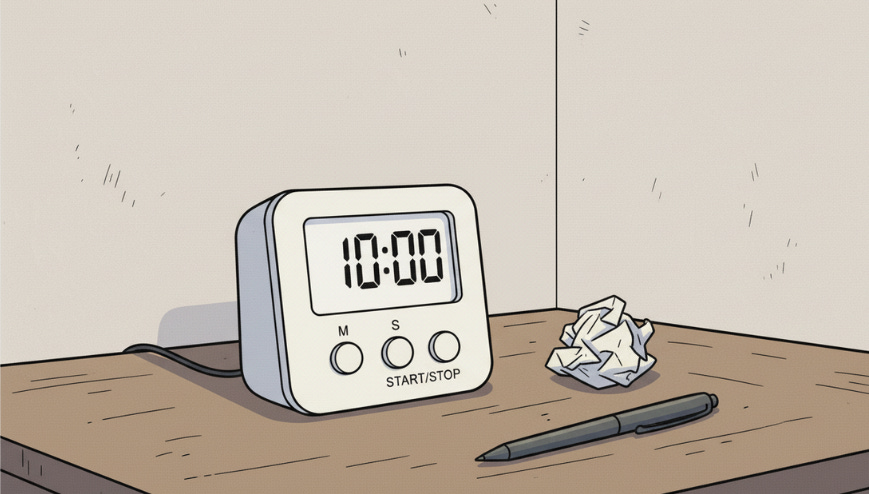
Set a timer if you have to.
This is the most important part. People need time to actually see the design before they react to it.
Most review meetings skip this. Someone throws the design up on screen and immediately starts explaining it. Nobody’s actually looking. They’re listening to you talk.
Silence first.
Minute 3-4: First impressions only
Go around the room. One sentence each.
“First thing I noticed was...”
Not “I think you should...” Not “What if we...”
Just: what did you see first? What stood out? What confused you?
This is pure signal. Before anyone’s overthinking it. Before anyone’s trying to solve problems.
You’re mapping how people’s brains actually parse the design.
Write it down. Don’t respond yet.
Minute 5-6: The zero context test
Now everyone pretends they’re an idiot.
You don’t know the company. You don’t know the product. You don’t read instructions.
Walk through the flow. Out loud.
“I land here. I see this button. I think it does... this?”
When someone says “wait, what?” - that’s your problem.
When someone has to guess what something does - that’s your problem.
When someone says “oh I didn’t even see that” - that’s your problem.
This is where ADHD brains are useful as fuck. We miss context naturally. We click the wrong things. We skim. We get confused.
That’s not a bug. That’s a feature.
Use it.
Minute 7-8: The specific questions
Remember those questions you sent in advance?
Now you ask them directly.
“Is step 2 clear?”
“Does the CTA make sense?”
“Can you tell what this button does?”
Specific questions get specific answers.
Not opinions. Not preferences. Answers.
Minute 9: Prioritization
You’ve got a list of issues now.
Rank them:
Breaks the flow (fix immediately)
Confusing but workable (fix if time)
Nice to have (backlog)
Do this out loud. In the room. Right now.
Not “I’ll think about it.” Not “We’ll discuss later.”
Decide.
Minute 10: Next steps
What’s getting fixed before this ships?
Who’s fixing it?
When are we looking at it again?
Write it down. Share it. Meeting over.
Why This Works
It respects everyone’s time.
Ten minutes. That’s it. You can stay focused for ten minutes.
It structures the feedback.
People know what to look for. They know how to give useful input. You’re not drowning in opinions.
It surfaces real problems.
Not hypotheticals. Not “what ifs.” Actual issues that actual users will hit.
It ships decisions.
You leave knowing what you’re doing. No ambiguity. No endless revision cycles.
The Part Nobody Tells You
Not everyone gets to give feedback on everything.
Some people are there to catch usability issues.
Some people are there to catch technical problems.
Some people are there to make sure it aligns with brand/business goals.
You need to know who’s checking what.
If everyone’s trying to check everything, you catch nothing.
Be explicit about this. “Sarah, you’re checking accessibility. Mike, you’re checking technical feasibility. Jordan, you’re checking if this makes sense for our users.”
Also: you don’t have to implement every piece of feedback.
You’re the designer. You’re making the call.
Listen to everything. Implement what matters. Politely ignore the rest.
The ADHD Accommodation Angle
This process is designed for ADHD brains.
Time-boxed. Ten minutes. You can’t lose focus because you don’t have time to.
Structured. You don’t have to remember what to ask. The process tells you.
Externalizes decision-making. You’re not holding everything in your head. You’re writing it down as you go.
Minimizes cognitive load. One question at a time. One focus at a time.
But here’s the thing:
What works for ADHD brains works for everyone.
Neurotypical people don’t want hour-long meandering feedback sessions either. They just tolerate them because that’s how it’s always been done.
Fuck that.
Try It This Week
Next design review you run: use this process.
Set a timer. Follow the structure. See what happens.
I’m betting you get better feedback in ten minutes than you’ve gotten in hour-long meetings.
Then hit reply and tell me how it went.
Or tell me I’m full of shit and your process is better.
Either way, I want to know.
P.S. - If you found this useful, hit that subscribe button. I write about UI/UX design, ADHD, AI disruption, and the uncomfortable stuff the games industry isn’t talking about. Sometimes all at once.