

So here’s the thing about design feedback.
You send off a mockup feeling pretty good about it.
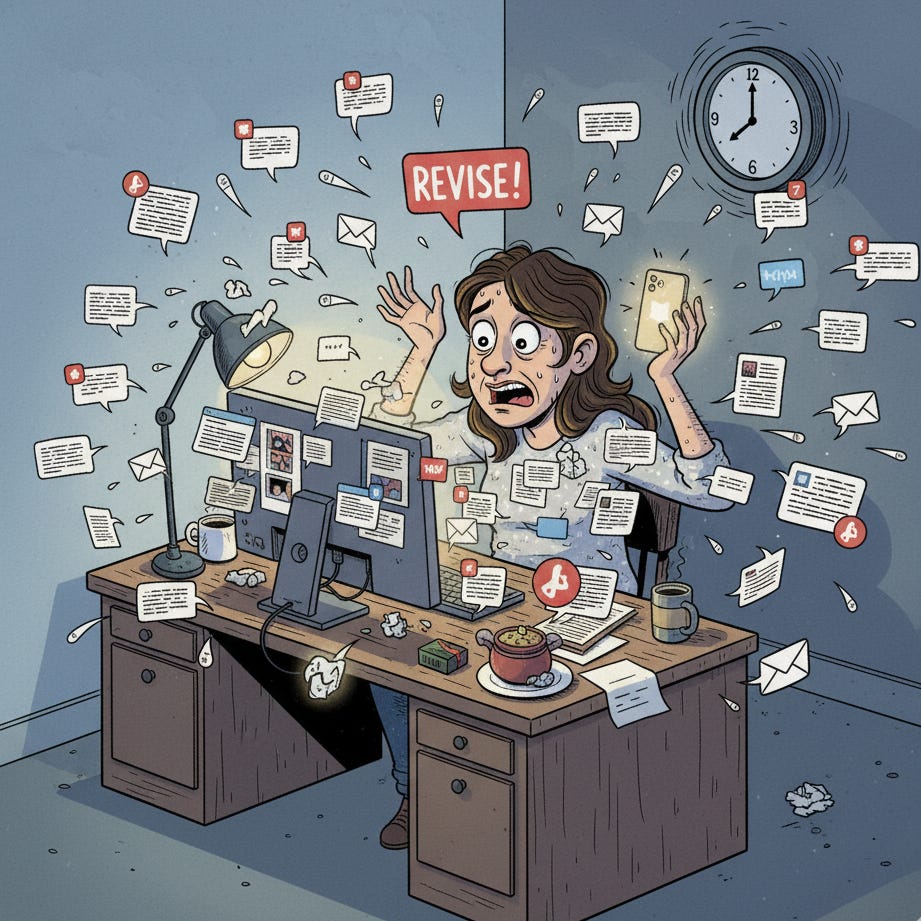
Then the producer sends back 37 comments spread across three different platforms… Slack, email, and somehow a voice note buried in your texts.
Half of them contradict each other. Two are about moving the same button to different places. One just says “make it pop” with zero additional context.
And suddenly your brain shorts out.
The Working Memory Problem
I know this feeling intimately.
Twenty-five years designing UI/UX, and the feedback stage still triggers my ADHD harder than anything else in the process.
Because here’s what happens: my brain tries to hold all 37 pieces of feedback in working memory simultaneously while also trying to figure out which ones actually matter and how they all fit together and whether that one vague comment about “energy” means they hate the whole direction or just want the CTA button a different color.
It’s cognitive overload disguised as collaboration.
And if you have ADHD? That working memory thing? Yeah, we’re running on about 30% capacity compared to neurotypical designers.
For years, I thought this was a personal failing.
Turns out it’s just an ADHD brain trying to use neurotypical systems.
But here’s where it gets interesting.
Enterprise ChatGPT has completely changed how I handle design feedback.
Not because it does the work for me.
But because it acts as external working memory and executive function in exactly the way my ADHD brain needs.
The System: Dump Everything Into AI
When feedback comes in now, I don’t try to process it myself anymore.
I dump everything into ChatGPT. Literally everything.
All the Slack messages, the email threads, the contradictions, the vague comments. Everything goes into one prompt.
Here’s roughly what I say:
I’m a UX designer with ADHD working on [project]. I just received design feedback from my producer and need help organizing it into actionable steps. Here’s all the feedback: [paste everything].

Please:
1) Identify contradictions and flag them as questions I need to ask
2) Group related feedback into themes
3) Prioritize by impact and effort
4) Create a numbered action list I can work through sequentially
5) Highlight any feedback that’s too vague to act on
What comes back is exactly what my brain needed but couldn’t create on its own.
What This Actually Looks Like
Here’s a real example.
Producer sent feedback on a mobile game UI redesign across three different channels. (Why do they do this to us?)
I copied everything into ChatGPT. The response organized 29 scattered comments into:
High Priority (Do First):
In-game HUD clarity issues (mentioned in 3 separate comments)
Store layout hierarchy problems
Touch target sizing for mobile
Medium Priority (Do Next):
Button state visibility
Typography hierarchy in menus
Needs Clarification (Ask Producer):
Contradiction: “Make daily rewards more prominent” vs “reduce UI clutter”
Vague: “Needs more energy” (ask for specific examples)
Suddenly I could breathe.
Instead of 29 things overwhelming my working memory, I had 3 clear next actions.
My ADHD brain can handle three things. It cannot handle 29 things.
Using AI for Implementation (Not Just Organization)
Once I have that prioritized list, I can use ChatGPT again for implementation.
Action item #1: “improve HUD clarity—players confused about what information to focus on during gameplay.”
I get specific:
I’m working on HUD clarity for a mobile action game. Current HUD shows health, energy, combo counter, timer, and mini-map simultaneously. Players report information overload during fast gameplay. Suggest 3 different HUD layouts that would improve clarity during combat, with pros/cons of each approach.
I’m not asking it to design for me. I’m asking it to break through the initial paralysis of “where do I even start” that kills momentum for ADHD brains.
Breaking the Implementation Anxiety Spiral
The “implementation anxiety” thing is real.
You know what I’m talking about.
You have a clear task: “Make the upgrade button more noticeable.”
But your brain goes: “Okay but how noticeable and what if I make it too aggressive and it feels predatory and should I add a glow effect or just increase size and what about the entire shop visual hierarchy and maybe I should redesign all the CTAs and...”
And 45 minutes later you haven’t changed anything because you spiraled into redesigning the whole monetization flow instead of just adjusting one button.
AI helps break that cycle.
I need to make an upgrade button more noticeable in a mobile game shop. Current button is medium blue with white text. Players aren’t seeing it among other UI elements. Suggest 3 alternatives that increase visibility while maintaining the game’s sci-fi aesthetic and not feeling predatory.
Three options. Pick one. Move forward.
Decision made. Momentum maintained.
The Secret Weapon: Batching Related Changes
The real game-changer: batching related changes.
When ChatGPT organizes feedback by theme… like “all HUD elements” or “all touch target sizing”—I can enter a flow state working on one type of problem.
Instead of: fix menu navigation, then HUD spacing, then store layout, then back to menu...
It’s: fix all touch target sizing in one focused session.
This is massively ADHD-friendly.
We’re terrible at task-switching but actually pretty good at hyperfocus when we can get into it. ChatGPT-organized feedback enables hyperfocus by removing the cognitive load of “what should I work on next?”
Handling the Hard Stuff
When Producers Contradict Themselves
“Make it bold and minimal.”
“Add more visual feedback but keep it clean.”
These statements are incompatible.
ADHD brain goes: “Both? BOTH?? HOW BOTH? SYSTEM ERROR.”
AI is weirdly good at identifying these contradictions and framing them as questions.
When ChatGPT flags a contradiction, it suggests: “Which is the higher priority, or is there a specific gameplay flow concern I should address instead?”
Now I have a clear, professional question to ask instead of just feeling confused and stuck.
Translating “Make It Pop”
Vague feedback is the worst for ADHD brains.
When a producer says “needs more energy,” my brain hears “you failed completely and this is garbage.”
AI helps translate vague feedback into specific questions:
Producer said design ‘needs more energy.’ Generate 5 specific clarifying questions I can ask to understand what they mean.
Response:
Is this about color vibrancy or overall visual hierarchy?
Are specific sections feeling flat, or is it the overall impression?
Would examples of designs with the right “energy” be helpful to share?
Is this about motion/animation, or static visual treatment?
Does “energy” relate to the brand personality we discussed, or something else?
Now you have a professional response instead of anxiety spiral.
What This Actually Is (And Isn’t)
Here’s what I’m not saying.
I’m not saying AI designs for you.
I’m not saying you don’t need design skills.
What I am saying: ChatGPT can act as external executive function for the parts of feedback management that crush ADHD brains.
It can:
Hold all feedback in “memory” when your working memory can’t
Organize chaos into structure
Identify contradictions you might miss while overwhelmed
Break big tasks into sequential actions
Generate options when your brain is stuck in paralysis
Translate vague feedback into specific questions
That’s... huge.
The Results
The productivity shift is wild.
Before ChatGPT feedback management: 3-5 days to process producer feedback and implement changes, with multiple anxiety spirals.
After: 4-6 hours of focused work, with clear action items and way less emotional damage.
Same designer. Same brain. Different tools.
How to Actually Do This
Practical implementation:
I keep a ChatGPT conversation thread called “Feedback Processing.”
Every time feedback comes in:
Dump everything in one message
Use the prompt structure I shared earlier
Get the organized action plan
Work through high-priority items first
Use ChatGPT again for implementation strategy on complex items
Time saved: Literally days per project.
The Real Point
The meta-lesson here:
ADHD designers aren’t bad at managing feedback because we’re disorganized or unfocused.
We’re bad at it because the traditional systems assume working memory and executive function we literally don’t have.
ChatGPT doesn’t fix ADHD.
But it can compensate for specific cognitive differences in ways that make us more effective.
It’s using available tools to work with your brain instead of against it.
So yeah...
If you’re drowning in design feedback right now, try dumping it all into ChatGPT and asking for help organizing it.
Worst case: you get a slightly different view of the same chaos.
Best case: you get your brain back.
P.S. — The producer who sent 37 comments across three platforms? After I used this system, I implemented everything in one day and they replied: “Wow, that was fast.” Yeah. Because ChatGPT helped me not spend four hours paralyzed by overwhelm first.
P.S. - If you’re new here, welcome. I write about UI/UX design, ADHD, navigating career changes, and the uncomfortable conversations we’re not having in the games industry. The stuff that matters but nobody wants to talk about.
If that sounds interesting, subscribe below. I send these out sporadically (because… ADHD), but when I do write, I promise it’s worth reading.