

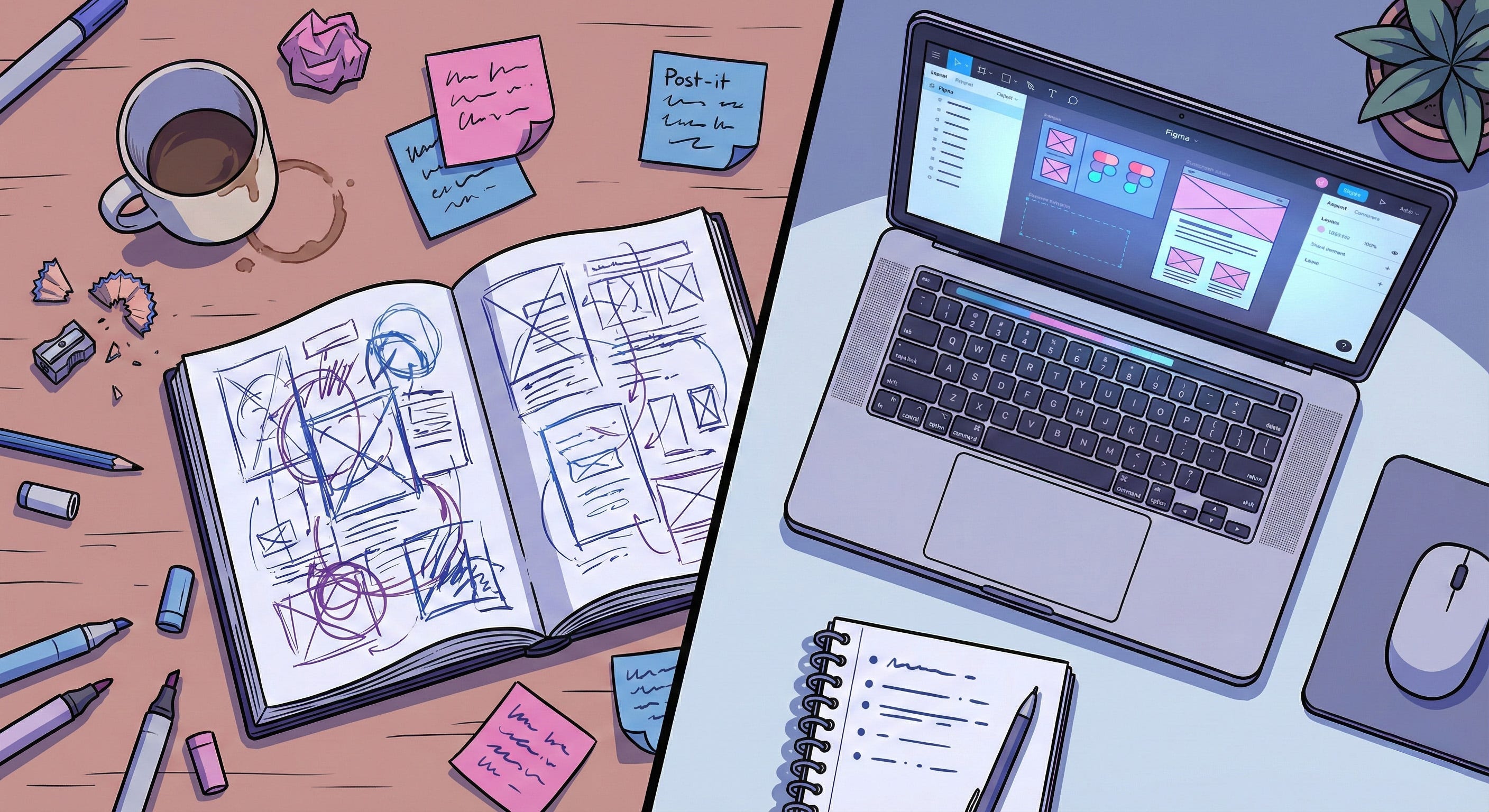
If you are an ADHD designer drowning in messy Figma files, this article will show you one thing.
How to turn hyperfocus into a system that actually ships work instead of burying you in chaos.
By the end, you will know exactly how to structure your files, where your messy ideas should live, how to extract the good stuff without losing momentum, and how to stop letting Figma trigger a meltdown.
Now let’s walk into the fire.
We all have that one file.
You know the one.
Untitled (4).
You open it and instantly regret your career choices.
Frames everywhere.
Auto Layout screaming.
Layers stacked like geological fucking sediment.
For an ADHD brain, the infinite canvas of Figma is not freedom.
It is a casino built to exploit our inability to stop making things.
We hoard ideas.
We hoard half executed components.
We hoard every shade of green we ever liked for one second.
And then the file becomes so overwhelming that we avoid it.
Not because we are lazy.
But because the chaos hits the nervous system like a truck.
Here is the truth.
Hyperfocus is not the villain.
Hyperfocus is the engine.
The problem is we try to aim it at two jobs.
Make cool things.
Organize cool things.
That split kills our flow.
So we need a container that respects the truth of our brain.
A system that lets chaos breathe without letting it spill everywhere.
A system that gives hyperfocus the playground it needs while keeping the deliverable clean.
Here is mine.
The Church & State Protocol
Design requires two different selves.
The Artist: The one who thrives in mess, colour, instinct, speed.
The Architect: The one who loves clean systems, good naming conventions, tidy components.
Doing both jobs at the same time short circuits the ADHD brain.
It forces you to shift states every five minutes.
It is like trying to run a marathon while doing your taxes.
So I split them completely.
Top half of the file is The Office.
Clean. Calm. Professional.
Bottom half is The Basement.
Chaotic. Emotional. Brilliant.
I use empty Pages as visual fences.
Literal blank dividers so my brain knows where it is allowed to be wild.
Here is the map.
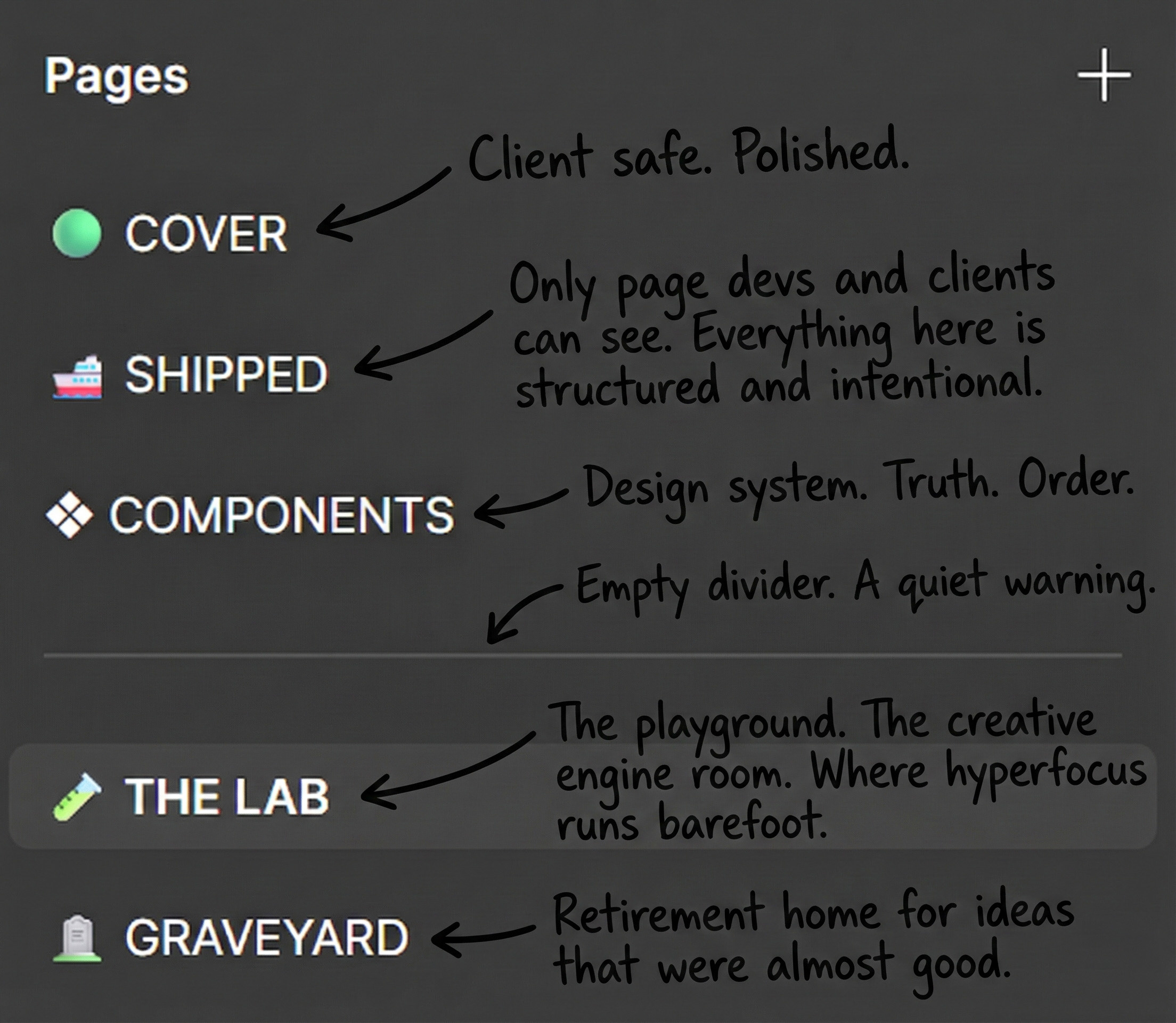
🟢 COVER
Client safe. Polished.
🚢 SHIPPED
Only page devs and clients can see.
Everything here is structured and intentional.
❖ COMPONENTS
Design system.
Truth.
Order.
---------------------
Empty divider.
A quiet warning.
🧪 THE LAB
The playground.
The creative engine room.
Where hyperfocus runs barefoot.
🪦 GRAVEYARD
Retirement home for ideas that were almost good.
How To Operate The System
The Lab is where the work actually starts to live.
But it has rules that protect you from yourself.
1. No Auto Layout
Auto Layout is brilliant for execution.
But it murders exploration.
It demands logic.
It demands discipline.
It demands you think about constraints before ideas.
So in the Lab, it is banned.
I drag. I distort. I create layouts that would make a developer cry.
This is where hyperfocus thrives.
Pure aesthetic instinct.
Pure dopamine.
2. The Extraction Ritual
Eventually, the chaos produces gold.
A card.
A header.
A layout with a pulse.
Then I extract.
Copy from Lab.
Paste into Shipped.
Now the Architect takes over.
Now the structure happens.
Now the naming conventions come online.
Two phases.
Zero conflict.
3. The Graveyard
ADHD brains hate deleting because it feels irreversible.
So I don’t delete.
I relocate.
Anything that stops serving the idea gets dragged to the Graveyard.
Out of sight.
Still safe.
No emotional cost.
I almost never go back.
But knowing I could keeps the panic quiet.
Why This Works
Hyperfocus is not designed for tidiness.
It is designed for depth and obsession and craft.
It can spend two hours tuning padding.
It can find the perfect shade of blue by feel.
It can generate twenty versions just to discover the one that sings.
But it cannot organize.
Expecting it to do both is a guarantee of burnout.
This system solves the real problem.
Not the mess.
The context switching.
It gives the Artist a place to play and the Architect a place to finish.
No collisions.
No guilt.
No cognitive whiplash.
When you separate the states, you finally get the best of your brain.
Not the exhausted version.
The weaponized one.
The Summary
If you skimmed everything above, here is the core.
Hyperfocus works beautifully when you aim it at one job.
Exploration or execution.
Never both.
Create a file structure that respects the split.
Let the Lab be messy.
Let Shipped be clean.
Move dead ideas to the Graveyard so your nervous system can rest.
Your Figma files get lighter.
Your process gets calmer.
Your hyperfocus stops working against you and starts working for you.
Stop fighting your hyperfocus.
Start weaponizing it.
Want more like this?
Paid subscribers get the full library of AI prompts I use for design work, weekly deep-dives on tools that actually help neurodivergent designers, and the stuff I can’t say in public.
No productivity porn. Just accommodations that work.